
Mastering the GS-14 Resume: Strategies for Success

Editor's Note: Fully rewritten March 2026 to reflect the Merit Hiring Plan two-page resume cap, four essay requirements, DoD civilian workforce reductions, and current GS-14 salary and qualification data. All statistics verified against OPM, BLS, and Federal News Network sources.
By Maryam House, MBA, CPRW, CARW, CERM, CMRW â Founder of ResumeYourWay | Certified Service-Disabled Veteran-Owned Small Business (SDVOSB) | 55+ years combined team experience in federal and military career services
Why the GS-14 Resume Has Changed More in the Last 12 Months Than in the Previous 20 Years
Key takeaway: If you're a DoD civilian or transitioning military officer targeting GS-14 positions in 2026, the resume you would have written a year ago will not work today. The two-page hard cap enforced by USAJOBS since September 2025, four mandatory essay prompts on every competitive posting, and the elimination of self-assessment questionnaires have fundamentally changed how you compete for these roles.
Here's what a GS-14 application looked like before 2025: you submitted an 8 to 12 page resume loaded with CCAR narratives, filled out a self-assessment questionnaire rating yourself on competency statements, and waited 80 to 120 days to hear back. The resume was the whole game. If you could demonstrate one year of specialized experience equivalent to GS-13, and your self-assessment scores were high enough, you made the cert list.
That system is gone.
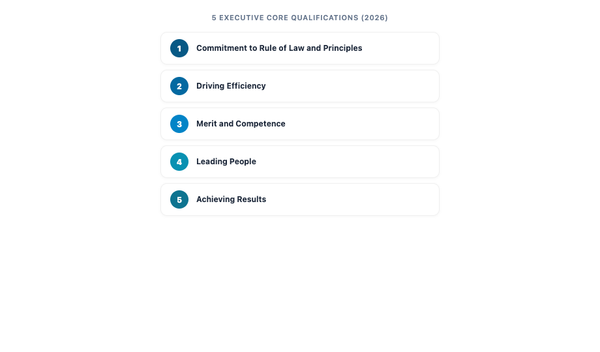
Under Executive Order 14170 and OPM's Merit Hiring Plan, competitive service postings at GS-05 and above now require a two-page resume (USAJOBS physically rejects anything longer), four short essay responses covering constitutional commitment, government efficiency, Executive Order alignment, and personal work ethic, and skills-based technical assessments instead of self-rated questionnaires.
For GS-14 candidates with 15 to 25 years of federal or military experience, compressing that career into two pages feels impossible. And for DoD professionals specifically, the challenge is doubled. You're not just fighting the format. You're translating defense-specific language, classified program references, and military command structures into something a civilian HR specialist can evaluate in under four minutes.
This article covers exactly how to do that in 2026.
What Does "Specialized Experience" Actually Mean for GS-14 Positions?
Key takeaway: To qualify for GS-14, you must demonstrate at least one year of specialized experience equivalent in scope and responsibility to the GS-13 level. For DoD transitions, this means translating military or defense-specific experience into OPM's qualification framework without losing the substance that makes you competitive.
OPM's General Schedule Qualification Standards haven't changed on this point. You still need one full year of specialized experience at the next lower grade. For GS-14, that's GS-13 equivalent. The experience must be directly relevant to the position's duties and must demonstrate the knowledge, skills, and abilities required for the role.
But here's what has changed: how you prove it. Before September 2025, you had pages to lay out your case. You could include detailed CCAR narratives, list every project, and walk the reviewer through your career chronologically. Now you have two pages. That means every line has to do double duty. Every sentence needs to simultaneously demonstrate specialized experience AND hit the keywords from the job announcement.
For DoD civilians targeting inter-agency lateral moves at GS-14, the specialized experience bar looks different depending on your series. A GS-14 Program Analyst (0343) in the Army needs to show experience managing multi-million dollar programs. A GS-14 IT Specialist (2210) at DISA needs to demonstrate enterprise-level system architecture or cybersecurity program management. A GS-14 Contract Specialist (1102) at DCMA needs acquisition experience at the ACAT level.
The common thread: GS-14 is where the federal government expects you to lead. Not manage tasks. Lead programs, people, and outcomes. Your resume has to reflect that in under 800 words of actual content (once you subtract headers, position blocks, and contact info from your two pages).
The DoD Workforce Is Shrinking. Here's What That Means for Your GS-14 Strategy.
Key takeaway: DoD has announced a 5 to 8 percent civilian workforce reduction target, approximately 50,000 to 60,000 positions. Nearly 21,000 have already accepted deferred resignation offers. If you're a DoD civilian, your GS-14 strategy needs to account for fewer internal promotion opportunities and increased competition for the positions that remain.
The Defense Department is in the middle of the largest civilian workforce reduction in decades. Under Executive Order 14210, agencies must hire only one new employee for every four that leave. DoD leadership has set a target of cutting 5 to 8 percent of the civilian workforce, and they're getting there through a combination of deferred resignation programs, early retirement offers, hiring freezes, and in some cases, reductions in force.
As of early 2026, nearly 21,000 DoD civilians have accepted deferred resignation offers. The hiring freeze means most vacancies aren't being backfilled. And OPM has proposed new RIF regulations that would prioritize performance ratings over tenure when deciding who stays and who goes.
What does this mean for your GS-14 resume? Three things.
First, internal promotions are harder to come by. If your agency isn't backfilling GS-13 vacancies, the pipeline to GS-14 narrows. You may need to look outside your current agency or even outside DoD entirely. Your resume needs to speak to reviewers who don't know your organization's acronyms or internal structures.
Second, competition for remaining GS-14 slots is fierce. The candidates who previously would have promoted internally are now competing for the same external postings you're applying to. Your resume can't just be adequate. It has to be the best two pages in a stack of 200.
Third, the private sector and defense contractor market is absorbing displaced DoD civilians at record rates. Companies like Booz Allen, Leidos, SAIC, and Northrop Grumman are actively recruiting former federal employees, especially at the GS-14 and GS-15 equivalent level. If you're considering that path, you need a private-sector resume too. And it looks nothing like a federal one.
How to Compress a 20-Year DoD Career Into Two Pages
Key takeaway: The two-page cap requires a fundamentally different approach. Focus on the last 10 years, use pipe-delimited position headers, lead with quantified accomplishments rather than duty descriptions, and save the full CCAR narratives for your master interview resume.
OPM's applicant guidance on the two-page limit is clear: focus on your most recent and relevant experience, typically the last 10 years. Anything older gets a single line at most. For a DoD professional with two decades of service, this means making hard choices about what stays and what goes.
Here's the formatting approach that works.
Consolidate each position header into a single line using pipe-delimited format: Job Title | Agency/Component | MM/YYYY - MM/YYYY | GS-XX | 40 hrs/wk. This format contains every required data point while freeing up vertical space. A four-position resume using this header style gains roughly eight additional lines for accomplishments compared to the traditional stacked header format.
For your two most recent positions (covering roughly the last 5 to 7 years), write 3 to 5 accomplishment statements per role. Each one should start with an action verb and include at least one quantified result. "Led cross-functional team of 12 across three directorates to deliver $4.2M modernization program 6 weeks ahead of schedule" is infinitely stronger than "Responsible for overseeing modernization programs within the directorate."
For older positions, compress to 1 to 2 lines each. Just enough to show progression and breadth. The reviewer needs to see that you've held increasing responsibility. They don't need the full story of every role you've ever had.
And here's what most people miss: you still need a full-length master resume. The two-page version is your gate pass. It gets through USAJOBS and lands on a reviewer's desk. The 5 to 10 page master resume is your interview weapon. It contains the detailed CCAR narratives, complete project descriptions, and operational specifics that interviewers need. You bring it to the panel. You reference it during behavioral questions. It never gets uploaded to USAJOBS.
Translating DoD Language for Civilian Reviewers
Key takeaway: The person screening your GS-14 application at a civilian agency has never heard of your COCOM, doesn't know what PPBE stands for, and can't evaluate your impact if everything is buried behind acronyms and classification caveats. Translate or lose.
This is where most DoD-to-civilian transitions fail. Not because the candidate lacks experience. Because the resume reads like a classified briefing instead of a career document.
Every DoD acronym needs to be spelled out on first use. Every military rank referenced needs a civilian equivalent in parentheses. Every program that can't be named due to classification needs a generic descriptor that still conveys scope. "Managed a $28M signals intelligence program supporting INDOPACOM operations" becomes "Managed a $28M intelligence collection program supporting theater-level operations in the Indo-Pacific region."
The same principle applies to leadership scope. "Commanded a battalion of 650 personnel" means nothing to a reviewer at HHS. "Led a 650-person organization responsible for logistics, personnel management, and operational readiness across 4 geographic locations" tells the same story in language any federal HR specialist can evaluate.
For GS-14 positions at civilian agencies, the key competencies reviewers look for are program or project management at scale, budget authority and financial stewardship, cross-organizational collaboration, policy development or implementation, and supervision of professional staff. Your resume needs to hit all five within two pages. Every bullet that doesn't serve one of these themes is wasting space you don't have.
The Four Essay Questions: What GS-14 Candidates Need to Know
Key takeaway: Every competitive service posting at GS-05 and above now includes four essay prompts. For GS-14 candidates, the bar is higher. Reviewers expect operational specifics, not platitudes. Your essays need to reflect senior-level experience and decision-making authority.
The Merit Hiring Plan introduced four short essay questions covering your commitment to the Constitution, how you've contributed to government efficiency, how a specific Executive Order applies to your role, and your personal work ethic. Each response is capped at 200 words.
OPM says these essays are "not scored" and optional for candidates. That framing is misleading. In a GS-14 competition where 200 qualified candidates apply for 3 positions, completing all four essays thoughtfully is the difference between making the cert list and getting screened out. The essays function as a tiebreaker and a character signal. Skip them at your own risk.
For the efficiency question, GS-14 candidates should reference program-level improvements with dollar amounts or time savings. For the Executive Order question, pick a politically neutral, operationally relevant EO. Safe choices include EO 14110 (AI and technology) for IT and program management series, EO 14249 (fraud and waste prevention) for financial and audit roles, and EO 14318 (permitting and infrastructure) for engineers and project managers.
And a critical warning: applicants must certify under 18 USC 1001 that they did not use AI tools to generate their responses. Human reviewers are trained to spot AI-generated text. Write in your own voice.
For a deeper breakdown of all four essay questions and the specific disqualification patterns to avoid, see our complete guide: The 4 Merit Hiring Essay Questions Are a Trap.
GS-14 Salary in 2026: What You're Actually Competing For
Key takeaway: A GS-14 Step 1 in the DC/DMV locality earns $143,913 in 2026. Step 10 reaches $187,086. With the locality adjustment at 33.94%, these are among the highest-paid non-SES positions in the federal government. The pay cap for GS employees is $197,200.
The 2026 federal pay raise was 1% across the board, with locality rates frozen at 2025 levels. For the Washington-Baltimore-Arlington locality area (which covers the entire DMV region), the locality adjustment is 33.94%.
That puts GS-14 Step 1 at $143,913 and GS-14 Step 10 at $187,086. With FEHB, FERS retirement contributions, TSP matching, and other benefits, total compensation for a GS-14 in the DMV exceeds $200,000 at mid-step levels. These numbers matter because they define what you're walking away from if you transition to the private sector without doing the math first.
Defense contractors typically offer higher base salaries (15 to 25 percent above GS equivalent) but weaker retirement benefits, less job security, and no within-grade increases. A GS-14 Step 7 making $172,000 with full FERS benefits may actually have better total compensation than a contractor role offering $195,000 base with a standard 401k match. Run the numbers before you jump.
For a complete breakdown of federal compensation beyond the base GS scale, including agencies that pay 40 to 80 percent more, see our guide: Federal Pay Secrets: The Agencies That Quietly Pay More.
Should You Go Private Sector Instead?
Key takeaway: The defense contractor market is actively absorbing displaced DoD civilians, especially at the GS-14 and GS-15 level. But the private-sector resume is a completely different document. If you're considering both paths, you need two separate resumes built for two different audiences.
With DoD cutting 50,000 to 60,000 civilian positions, a lot of GS-14 professionals are looking at the private sector for the first time. And the market is receptive. Defense contractors need people who understand DoD acquisition, logistics, intelligence, and IT systems. They're hiring from the same pool that DoD is shrinking.
But here's the mistake most people make: they submit their federal resume to a defense contractor. That doesn't work. A private-sector resume is two pages max (which you now have), but it uses a completely different format. No hours-per-week. No supervisor contact information. No series numbers. Instead: a professional summary at the top, skills-based keywords aligned to the job description, and accomplishments framed around business impact rather than government mission.
If you're applying to both federal and contractor positions simultaneously, you need three documents: a two-page federal submission resume for USAJOBS, a two-page private-sector resume for contractor applications, and a master resume for interview preparation that covers everything in detail. ResumeYourWay builds all three as part of our Federal to Civilian Transition packages.
Frequently Asked Questions
What qualifications do I need for a GS-14 position?
You need at least one year of specialized experience equivalent to the GS-13 level. The experience must be directly relevant to the position and demonstrate the knowledge, skills, and abilities listed in the job announcement. Most GS-14 positions also require demonstrated leadership, program management capability, and the ability to work across organizational boundaries.
How do I fit a 20-year DoD career into two pages?
Focus on the last 10 years. Use pipe-delimited position headers to save space. Lead with 3 to 5 quantified accomplishments per recent role. Compress older positions to 1 to 2 lines showing progression. Keep a separate full-length master resume for interview preparation.
Is the two-page limit enforced by USAJOBS?
Yes. Since September 2025, USAJOBS physically rejects uploaded resumes that exceed two pages. There are no exceptions. The limit applies to all competitive service positions at GS-05 and above, including SES. For detailed formatting strategies, see our guide: The 2-Page Federal Resume Is a Trap.
Do I need to answer the four essay questions?
OPM says the essays are optional for applicants. In practice, completing them thoughtfully gives you a measurable competitive advantage, especially for GS-14 positions where competition is intense. We strongly recommend answering all four.
What's the GS-14 salary in the DC area for 2026?
GS-14 Step 1 in the DC/DMV locality pays $143,913. Step 10 pays $187,086. The locality adjustment is 33.94%. Total compensation including benefits exceeds $200,000 at mid-step levels.
Should I transition to a defense contractor instead?
It depends on your priorities. Contractors typically offer 15 to 25 percent higher base pay but weaker benefits. With DoD reducing its civilian workforce by 50,000 to 60,000 positions, the contractor market is actively hiring former federal employees. But you need a completely different resume for private-sector applications.
Ready to Get Started?
ResumeYourWay specializes in DoD-to-civilian transitions and GS-14/GS-15 federal resume writing. Our 55+ Subject Matter Experts and 30+ Certified Writers (CPRW, CARW) understand exactly what federal reviewers look for at the senior level. We build the compressed two-page submission resume, the full master interview resume, and if you're exploring contractor roles, the private-sector version too.
Having supported 110,000+ clients since 2014 with a 92% interview success rate, we know what works.
Explore Federal Resume Packages | Schedule a Free Consultation
Active-duty military and veterans: Use code MILVET10 for 10% off all services.


Get the resume that gets you interviews.
110,000+ clients served since 2014. 100% human-written. Built for your exact situation.
No AI. No templates. Veteran-owned.