
The 2-Page Federal Resume Rule: How to Fit Your Career on 2 Pages for USAJOBS

Editor’s Note: Updated March 2026 to reflect current USAJOBS enforcement of the two-page resume limit under the Merit Hiring Plan, OPM formatting guidance, and skills-based assessment requirements.
By Maryam House, MBA, CPRW, CARW, CERM, CMRW, Founder & COO of ResumeYourWay | Certified Service-Disabled Veteran-Owned Small Business (SDVOSB)
Why Does the 2-Page Federal Resume Rule Change Everything for USAJOBS Applicants?
Key takeaway: USAJOBS now physically rejects any resume longer than two pages. This is not a guideline. It is a hard technical cap enforced since September 2025 under the Merit Hiring Plan. Federal applicants who previously submitted long-form resumes must fundamentally rethink how they present their qualifications or risk automatic rejection before a human ever sees their application.
For more than two decades, federal resume writing operated under one unspoken rule: more is more. Applicants routinely submitted long documents packed with CCAR narratives, compliance language, and every GS-level detail from a 20-year career. It worked, or at least, it did not get you disqualified.
That era ended on September 27, 2025.
Executive Order 14170, signed in January 2025, directed the Office of Personnel Management to overhaul the federal hiring process. The resulting Merit Hiring Plan introduced a strict two-page resume limit that USAJOBS now enforces at the upload level. Submit a three-page document, and the system rejects it outright: no partial upload, no warning, no workaround (Source: OPM Merit Hiring Plan Resources).
This article breaks down exactly what changed, what the new format demands, and how to compress a decades-long federal career into two pages without losing the substance that gets you referred.
What Changed Under the Merit Hiring Plan, and Why Did OPM Eliminate Long Resumes?
Key takeaway: OPM stopped using self-assessment questionnaires to rank applicants, required skills-based technical assessments instead (questionnaires can still screen you on minimum qualifications), and eliminated the need for lengthy narrative resumes. The two-page cap reflects a shift toward evaluating demonstrated competencies rather than detailed career histories.
The Merit Hiring Plan introduced three structural changes that make the two-page resume not just a formatting preference but a strategic necessity.
Change 1: The two-page hard cap. USAJOBS began physically enforcing the limit in September 2025. The system measures uploaded documents and rejects anything exceeding two standard pages. Competitive Senior Executive Service (SES) positions follow it too. The exceptions are narrow: VA Title 38 and Hybrid Title 38 roles are exempt, and some announcements set their own rule, so read yours.
Change 2: Self-assessment questionnaires no longer rank you. The old system asked applicants to rate themselves on occupational competencies, and those ratings ranked them. Self-assessment questionnaires didn't go away, and many still ask detailed, job-specific questions. Since September 30, 2025, OPM says agencies should not rank you on those self-ratings (GS-4 and below, seasonal and some Federal Wage System jobs excepted), and a skills assessment is required too. Your resume has to back every answer.
Change 3: Essay questions added. Agencies now have to include short essay questions on GS-5 to GS-15 postings (optional on merit promotion ones). They aren't scored, and skipping them never disqualifies you. Each response has a 200-word limit, and the answers have to be in your own words. The questions cover commitment to the Constitution, government efficiency and work ethic. In September 2026, after a federal court stayed the Executive Order question, OPM replaced it on announcements opening September 19, 2026 or later, and agencies are set to add a fifth, agency-specific question.
| Factor | Pre-2025 Federal Hiring | 2026 Merit Hiring Plan |
|---|---|---|
| Resume length | Long-form (no hard limit) | 2-page hard cap enforced by USAJOBS |
| Self-assessment questionnaires | Required for rating/ranking | Still screen; no longer rank (since Sept. 30, 2025) |
| Essay questions | None | Short essays, 200 words each (optional, not scored) |
| Assessment method | Self-rated questionnaires | Skills-based technical assessments |
| Hiring timeline target | 101 days average (FY 2024) | 80 days or less (OPM directive) |
| SES application | ECQ narrative essays | 2-page resume + structured interviews |
How Do You Fit a 20-Year Federal Career Into Two Pages?
Key takeaway: Prioritize the last 10 years of experience, lead with quantified accomplishments rather than duty descriptions, and eliminate compliance boilerplate that added bulk without adding value. Every line must earn its space.
The biggest mistake applicants make under the new system is trying to compress their old long-form resume into two pages by shrinking the font and eliminating white space. That approach fails on two levels: it becomes unreadable for human reviewers, and it signals that you cannot prioritize information, a core competency for most federal roles.
Instead, treat the two-page limit as a strategic exercise in relevance.
Strategy 1: Lead with impact, not chronology. Open each position with your strongest quantified accomplishment. Instead of listing GS-level, series, and hours per week as the first lines (which consumed valuable space under the old format), put your most compelling result first. The compliance details can follow in a single condensed line.
Strategy 2: Prioritize the last 10 years. OPM guidance emphasizes recent and relevant experience. Positions older than 10 years can be compressed into a single-line entry with title, agency, and dates, or omitted entirely if they do not directly support the target position.
Strategy 3: Eliminate narrative padding. The old federal resume format rewarded phrases like "Served as the primary point of contact responsible for the oversight and management of..." Under the new system, that same content should read: "Managed [specific program], resulting in [quantified outcome]." Cut the preamble. Keep the proof.
Strategy 4: Use a hybrid format. Combine a brief professional summary (3-4 lines maximum) with reverse-chronological experience entries that emphasize results. This format suits the human reviewer’s need to quickly assess qualifications.
What Formatting Mistakes Will Get Your Federal Resume Rejected?
Key takeaway: Follow OPM's formatting recommendations: a sans-serif font such as Calibri or Arial, about 10-point body text, 0.5-inch margins, and a PDF so your formatting and page count hold. Skip graphics and multi-column layouts.
The two-page limit is measured by the USAJOBS upload system, which means formatting choices directly affect whether your resume passes the technical gate.
Mistake 1: Using headers and footers. Many applicants place their name and contact information in a document header. Place all content in the main document body.
Mistake 2: Graphics, logos, and text boxes. Any visual element that is not plain text eats space you need. Charts showing "skill levels" and decorative borders waste room, and USAJOBS tells applicants not to include photos of themselves.
Mistake 3: Shrinking below 10pt font. Reviewers who evaluate hundreds of resumes per vacancy will not struggle through 8pt text. OPM's formatting guidance recommends about 10-point body text and 14-point titles.
Mistake 4: Multi-column layouts. Two-column designs may look modern, but they make it harder for an HR specialist to find the dates, hours and specialized experience for each role.
How Should Transitioning Service Members Approach the 2-Page Limit?
Key takeaway: Military experience needs to be translated into civilian-equivalent language and distilled to mission-critical accomplishments. Rank, MOS codes, and unit designations should be translated or removed unless directly relevant to the target federal position.
Transitioning service members face a unique challenge under the two-page limit. Military careers generate extensive documentation, such as fitness reports, evaluation narratives, deployment histories and training records, that previously translated into detailed federal resumes. Under the new system, all of that must fit into two pages.
The key is translation and prioritization. A service member with 20 years and multiple deployments should not list every assignment. Instead, focus on the three to four most relevant positions that demonstrate the competencies required for the target federal role. Translate military jargon into language that a civilian HR specialist can evaluate without a military glossary.
For example, instead of "Served as Battalion S-3 responsible for MDMP and COA development across a 4,000-soldier BCT," write: "Directed operations planning for a 4,000-person organization, coordinating resource allocation, risk assessment, and multi-phase project execution across a $50M annual budget."
ResumeYourWay has helped more than 110,000 clients, including thousands of transitioning service members, get through federal hiring requirements. Our team includes 17 former federal hiring managers and understands both the military evaluation system and the federal HR screening process.
What About Senior Executive Service (SES) Applications Under the New Rules?
Key takeaway: SES applications no longer use separate ECQ narratives. The Merit Hiring Plan replaces them with a two-page resume plus structured interviews. This is the most dramatic change in executive-level federal hiring in over two decades.
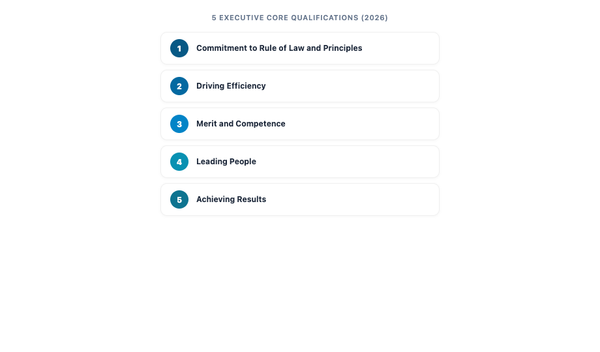
One common way to apply for SES used to be five separate Executive Core Qualification essays plus a detailed resume. It was widely considered the most demanding application process in the federal government.
Under the Merit Hiring Plan, SES applications follow the same two-page resume format as all other competitive service positions. Candidates now show the ECQs inside that two-page resume, with no separate narratives, and OPM assesses them in a structured interview during Qualifications Review Board certification.
This change benefits strong performers who interview well but struggled with the essay format. It challenges candidates who relied on polished ECQ narratives written by professional services. Either way, the two-page resume must now carry the full weight of demonstrating executive-level qualifications, making every word choice critical.
Frequently Asked Questions About the 2-Page Federal Resume
Does the two-page limit apply to all federal positions?
It applies to competitive service jobs, and OPM applies it to Title 5 excepted service, merit promotion and Direct-Hire Authority postings too. VA Title 38 and Hybrid Title 38 roles are exempt, and some announcements set their own rule, so read yours.
Can I attach supplemental documents to exceed two pages?
No. The two-page limit applies to the resume document itself. Supplemental documents such as transcripts, DD-214s, and SF-50s are uploaded separately and do not count toward the page limit.
What if I have 25+ years of federal experience?
Prioritize the last 10 years of relevant experience with detailed entries. Earlier positions can be listed in a condensed "Prior Experience" section with title, agency, and dates only. Focus on depth of impact in recent roles rather than breadth across your entire career.
Should I use the USAJOBS resume builder or upload a document?
The USAJOBS resume builder automatically formats your content and manages page limits. However, uploaded documents give you more control over layout and visual presentation. If you upload, verify the file is exactly two pages before submitting. The system provides no partial credit for a 2.1-page document.
How does ResumeYourWay help with the two-page federal resume?
Our team of certified federal resume writers (CPRW, CARW, CERM, CMRW) has adapted our process specifically for the Merit Hiring Plan requirements. We help clients distill complex federal careers into two strategically optimized pages built for HR's qualification review and the hiring manager. We've worked with 110,000+ clients since 2014, with a 92% interview rate within 45 days.
Ready to Get Your Federal Resume Right?
The two-page federal resume is not going away. Every week that passes with an outdated, oversized resume in your USAJOBS profile is a week of missed opportunities.
ResumeYourWay specializes in federal resume writing, and our team has already helped thousands of applicants successfully transition to the new two-page format. Every resume is written by a certified human expert, not AI-generated templates.
Explore our federal resume writing packages, starting at $479 for our Bronze package. Active-duty military and veterans: Use code MILVET10 for 10% off.
Related reading:


Get the resume that gets you interviews.
110,000+ clients served since 2014. 100% human-written. Built for your exact situation.
No AI. No templates. Veteran-owned.