
5 Silent Tripwires Killing Your Veteran Job Search in 2026 (Updated March 2026)

You did everything right. Attended your Transition Assistance Program class, rebuilt your resume around transferable skills, swapped every piece of military jargon for civilian phrasing, and started firing off applications. Forty, fifty, maybe more. Nothing came back. No phone screens. No interviews. Just silence.
You are not imagining it. The Bureau of Labor Statistics reported veteran unemployment at 4.0% for January 2026, which sounds healthy until you realize the number obscures massive underemployment, six-figure salary shocks, and thousands of qualified service members getting silently filtered out by application systems that were never designed to interpret military careers.
The transition pipeline has structural flaws that nobody warned you about. Not your command team, not your TAP facilitator, and certainly not the LinkedIn influencer telling you to "just network harder." What follows are the five traps most likely to stall your civilian career before it starts, along with the specific countermeasures that actually work.


Trap #1: The "Hours Worked" Disqualification
This one catches almost every transitioning service member applying to federal positions, and most never find out why they were screened out.
Federal human resources specialists operate under strict crediting rules. When they evaluate your resume for qualifying experience, they can only count work that is tied to a specific employer, a date range, and a weekly hour figure. If your resume has a standalone "Skills" section or a "Summary of Qualifications" block floating at the top with no organizational context, no employment dates, and no hours-per-week notation, every competency listed in that section legally counts as zero weeks of experience. It simply cannot be credited.
The critical detail most veterans miss: if you fail to include "Hours Worked: 40 hrs/week" (or equivalent) beneath a dated position block, that entire role can be treated as if it never happened. An HR specialist reviewing 200 applications does not have the authority to assume your hours. They must see the number on the page. No number, no credit.
The fix: Strip out any freestanding skills section entirely. Every keyword, competency, and qualification must live inside a chronological position entry that includes your unit or command as the employer, exact service dates, and "40 hours per week" explicitly stated. Weave technical skills into accomplishment bullets rather than listing them in isolation. This is the only format that federal HR can legally use to build your qualification case.
Trap #2: The Specialized Experience Catch-22
Every federal job announcement lists "Specialized Experience" requirements, usually one to three paragraphs describing exactly what the agency needs. Here is the part that TAP classes skip over: the HR specialist reviewing your application is not permitted to infer, interpret, or extrapolate from your military experience. They cannot look at your record as an NCOIC and conclude that you probably managed budgets. If you do not explicitly state it, it does not exist in their evaluation.
This creates a paradox. You have exactly the experience the agency needs, but your resume describes it using military frameworks that an HR specialist (who may have no military background) cannot map to the announcement language. The result: technically qualified candidates getting rated "not qualified" because the evidence was presented in the wrong dialect.
The fix: Use what career strategists call the Spoon-Feed approach. At the top of page one, directly beneath your contact information, place a specialized experience summary paragraph that answers the job announcement point by point. Use the announcement's skill terms where they truthfully describe your work, so HR can check each box without guessing, but describe that work in your own words with your own results. Every KSA (Knowledge, Skill, Ability) referenced in the announcement should be backed by a real example somewhere in your resume.
Trap #3: The Over-Translation Danger
Everyone tells you to civilianize your resume. What nobody tells you is that over-translation is just as deadly as under-translation.
Generic resume translation tools and well-meaning advisors often produce impressive-sounding titles that correspond to nothing in any applicant tracking system. When your resume says "Supply Chain Harmonization Leader" but the ATS is scanning for "Logistics Supervisor" or "Warehouse Operations Manager," you get rejected before a human ever sees your name. The more creative the title translation, the less likely the algorithm is to match it.
There is a second risk specific to veterans with active security clearances. For non-cleared civilian positions, listing TS/SCI or higher clearance levels on your resume can actually work against you. Some hiring managers see an active clearance and assume you will leave the moment a cleared position opens up at a defense contractor. You become a "flight risk" in their eyes, which is ironic given that you are trying to leave that world behind.
The fix: Pull your job titles and skill terminology directly from the target job description. Do not invent titles. Match them. If the posting says "Program Analyst," your resume should reflect "Program Analyst" responsibilities, not "Strategic Programmatic Synergy Coordinator." For non-cleared roles at civilian employers, seriously evaluate whether including your clearance level helps or hurts. If the job does not require a clearance, leaving it off may remove an objection you never knew existed.


Trap #4: "Referred But Ghosted"
Few words give transitioning veterans more false hope than "Referred" on a USAJOBS application status. Most people interpret it as meaning they are a serious contender. In practice, it means you met the minimum qualifications and scored at or above the cutoff on the agency's assessment. You have cleared the lowest bar in a multi-stage process.
Under the older Rule of Three system, agencies were limited to choosing from the top three candidates on the referral certificate. That constraint has been replaced by the Rule of Many, which establishes a numerical cutoff score and refers everyone who meets or exceeds it. Instead of competing against two other finalists, you may be one resume on a much longer referral list. Veterans' preference still applies: points are added to your passing score, and veterans with a service-connected disability of 10 percent or more go to the top of the list, except for scientific and professional jobs at GS-9 and above.
This means your resume now has to serve two audiences simultaneously. The first audience is the HR specialist checking your qualifications: they need your specialized experience stated plainly against the announcement, in your own words, with dates and hours on every role. The second audience is the hiring manager who will skim your resume for roughly 15 seconds after pulling it from a large referral stack. That person is looking for proof of ROI, not a list of duties.
The fix: Structure every accomplishment bullet using the X-Y-Z format: "Achieved [measurable result], through [specific action taken], using [tools, methods, or resources]." This format satisfies both audiences. The HR specialist sees the specialized experience spelled out. The hiring manager sees quantified impact at a glance. Replace every "responsible for" with a result that has a number attached to it.
Trap #5: The Salary Shock
Military compensation is structured so differently from civilian pay that direct comparisons are almost meaningless without a calculator and a tax table. Most veterans discover this gap at the worst possible moment: when they receive their first civilian offer and realize the number that sounded generous is actually a pay cut.
The math is brutal. Basic Allowance for Housing (BAH) and Basic Allowance for Subsistence (BAS) are completely tax-free. Civilian salary is 100% taxable at both federal and state levels. If you have been stationed in a no-income-tax state like Florida, Texas, or Nevada, that protection vanishes the moment you take a job in Virginia, California, or Maryland. Healthcare shifts from Tricare (effectively zero out-of-pocket for most active-duty families) to employer-sponsored plans costing anywhere from $6,000 to $10,000 annually in premiums and deductibles. BAH adjusts with housing market inflation; most civilian raises do not keep pace with rent increases in the same markets.
Here is what those numbers translate to in practice. An E-6 with 10 years of service and a family typically needs a civilian salary in the $92,000 to $98,000 range to maintain the same effective purchasing power. An O-3 with 8 years needs roughly $145,000 to $155,000. These figures shock veterans who expected their military experience to command premium civilian compensation, only to realize the "premium" barely covers the benefits they lost.
The fix: Before you entertain any offer, run your current total military compensation through the Regular Military Compensation (RMC) calculator. Factor in your state income tax exposure, projected healthcare costs, and the loss of tax-free allowances. Establish your "walk-away number," the minimum civilian salary you need to avoid a real lifestyle downgrade, before you start interviewing. Knowing this figure prevents desperation decisions and gives you a concrete basis for salary negotiation.
The SkillBridge Lottery
On paper, the DoD SkillBridge program is one of the best transition tools available: up to 180 days of civilian work experience at a host company while you continue drawing military pay and benefits. In practice, accessing it is closer to winning a lottery where your commanding officer holds the only ticket.
Commanders have sole approval authority over SkillBridge participation, and "mission requirements" is the default justification for denial. No appeal process exists that bypasses the command chain. Persistent rumors about the program being scaled back or sunset have caused some commands to preemptively deny requests under the logic that they should not lose personnel to a program that might not exist in six months. A June 2025 automation update further complicated the process by removing Education and Training offices from the review loop, placing the entire administrative burden on the commander and the service member.
Hiring Our Heroes, one of the largest SkillBridge fellowship providers, has drawn criticism from participants for poor communication during the matching process and no guaranteed placement at the end of the fellowship period. You can complete 12 weeks of unpaid corporate internship and still walk away without a job offer.
What to do: Start the SkillBridge conversation with your chain of command as early as possible, ideally 12 to 18 months before your ETS/EAS date. Document everything in writing. Have a backup transition plan that does not depend on SkillBridge approval. If denied, focus your energy on direct applications and networking rather than fighting a bureaucratic battle you are unlikely to win.
VR&E: The Lifeline That Is Harder to Access Than You Think
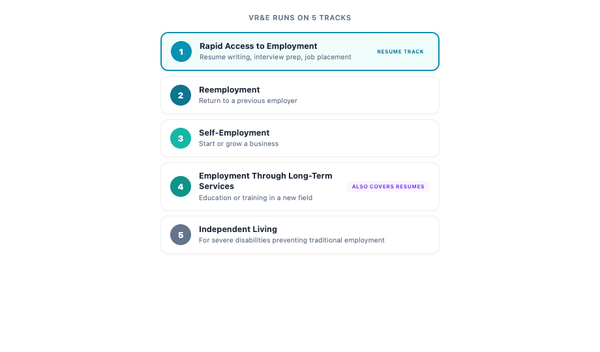
Vocational Rehabilitation and Employment (VR&E), formally known as Chapter 31, provides tuition, monthly subsistence, equipment, and career services for veterans with service-connected disabilities. For those who qualify, it is one of the most comprehensive benefits available. The problem is qualification itself.
Resume writing is one of the career services VR&E can cover. If you're referred, our veteran resume help for VR&E participants is built for exactly that path.
The Serious Employment Handicap (SEH) barrier remains the most contentious gatekeeping mechanism in the program. Whether a veteran's disability constitutes a "serious" employment handicap is assessed subjectively by individual VR&E counselors, producing wildly inconsistent outcomes across regional offices. Two veterans with identical ratings and employment histories can receive opposite determinations depending on their assigned counselor.
The FAST VETS Act, which took effect in January 2026, was intended to speed up the process but has introduced what some advocates call "redevelopment hell," additional administrative layers that slow initial enrollment rather than accelerating it. Monthly subsistence payments sit at $812.84 for 2026, an amount that does not cover rent in most markets where veterans are concentrated.
One piece of good news that many veterans are unaware of: the old 12-Year Rule, which previously imposed a deadline on VR&E eligibility, has been effectively eliminated for anyone who separated after January 2013. If you separated within the past 13 years and have a service-connected disability rating, you may still be eligible regardless of how long ago you left the military.
The Rule of Many: What It Actually Changed
For decades, federal hiring operated under the Rule of Three: an agency could only interview and select from the top three candidates on a referral certificate. This created a narrow, predictable process. The replacement, often called the Rule of Many, fundamentally restructured how referral lists work.
Under the new framework, agencies set a numerical cutoff score based on the qualification assessment. Every applicant who meets or exceeds that threshold gets referred. In practice, referral lists can be much longer than three names. Veteran preference points still apply to your score, but you're no longer competing with just two other finalists. Hiring managers have far more latitude to select from a broader pool, which can either help or hurt depending on how your resume stacks up against a larger field.
The strategic implication is clear: "Referred" is no longer a meaningful milestone. Your resume needs to be strong enough to stand out in a pool of dozens, not just strong enough to get referred. Quantified accomplishments, specialized experience stated plainly against the announcement, and a clear ROI narrative are no longer optional. They are the minimum bar for getting an interview under the new system.
The "Veteran Friendly" Mirage
Companies love publicizing their veteran hiring commitments. Press releases, career fair sponsorships, LinkedIn badges, and internal pledges all paint a picture of organizations eager to bring military talent through the door. Some of this is genuine. Much of it is performative.
The HIRE Vets Medallion Award (offered at Platinum and Gold levels) is a legitimate Department of Labor recognition based on verified hiring and retention data. Companies that hold it have demonstrated real commitment through measurable outcomes. But even at Platinum-level employers, a fundamental disconnect often exists between the corporate diversity office that signed the pledge and the individual hiring manager reviewing your application. That manager may still run your resume through an ATS that cannot parse military experience. They may still question why someone with a decade of leadership experience is applying for a mid-level role. The corporate commitment does not automatically translate into an interview.
What to do: Look beyond the badge. Research the company's actual veteran employee resource groups. Connect with veterans who already work there and ask direct questions about the hiring process. Use the "veteran friendly" label as a starting point, not a guarantee. And always apply with a resume optimized for their specific ATS. Corporate goodwill does not override what the screening software decides.


Frequently Asked Questions
Why does my federal resume keep getting disqualified even though I have the experience?
The most common cause is formatting, not qualifications. Federal HR specialists can only credit experience that appears under a dated position block with an employer name and explicit hours-per-week notation. Skills listed in standalone summary sections, no matter how relevant, receive zero credit during the qualification review. Restructuring your resume into strict chronological format with hours stated under every position typically resolves this.
How much civilian salary do I actually need to replace my military compensation?
It depends on your rank, years of service, duty station BAH rate, family size, and the state where you plan to work. As a rough benchmark, enlisted E-6 members with 10 years typically need $92,000 to $98,000 in civilian salary to maintain equivalent purchasing power. Officers at the O-3 level with 8 years generally need $145,000 to $155,000. Use the DoD Regular Military Compensation calculator and add projected costs for healthcare premiums, state income tax, and housing market adjustments in your target location.
Can my commander deny SkillBridge even if I meet all the eligibility requirements?
Yes. Commanding officers have sole approval authority over SkillBridge participation, and "mission requirements" is a sufficient justification for denial with no formal appeal mechanism. Start the conversation early (12 to 18 months before separation), submit your request in writing, and always maintain a parallel transition plan that does not depend on SkillBridge approval.
Is the 12-Year Rule for VR&E still in effect?
For veterans who separated after January 2013, the 12-Year Rule has been effectively eliminated. If you have a service-connected disability rating and separated within the past 13 years, you likely remain eligible for Chapter 31 benefits regardless of how much time has passed since your discharge. Contact your regional VR&E office to confirm your individual eligibility.
Why did I get "Referred" on USAJOBS but never receive an interview?
Under the Rule of Many, being referred simply means you scored above the numerical cutoff, along with every other applicant who cleared it. Hiring managers review the entire referral stack and select candidates whose resumes most clearly demonstrate measurable impact and role-specific fit. To stand out, restructure your accomplishments using the X-Y-Z format (result achieved, action taken, tools used) and make sure your experience answers the announcement in your own words.
Should I remove my security clearance from my resume for civilian jobs?
It depends on the target role. For positions that require or prefer a clearance (defense contractors, intelligence community, cleared IT), absolutely include it. For non-cleared civilian roles at companies with no government contracts, listing an active TS/SCI can sometimes flag you as a "flight risk" in the eyes of hiring managers who assume you will leave for a higher-paying cleared position. Evaluate each application individually and consider removing it when the role has no security requirement.
Get a Resume That Clears Every Tripwire
ResumeYourWay is a Service-Disabled Veteran-Owned Small Business and trusted VR&E provider listed on the NEST database. Our military transition packages are built by veterans who've been through these exact traps. 55+ SMEs, 28+ certified resume writers, a 92% interview rate within 45 days, 110,000+ clients since 2014. HIRE Vets Medallion Award (Platinum).
View Military Transition Packages Schedule Free ConsultationRelated Military Transition Resources


Get the resume that gets you interviews.
110,000+ clients served since 2014. 100% human-written. Built for your exact situation.
No AI. No templates. Veteran-owned.