
The 2-Page Federal Resume Is a Trap
The complete technical manual for surviving the Great Compression: formatting, the Dual-Format Strategy, SME review mechanics, and the "Other Documents" decision matrix.
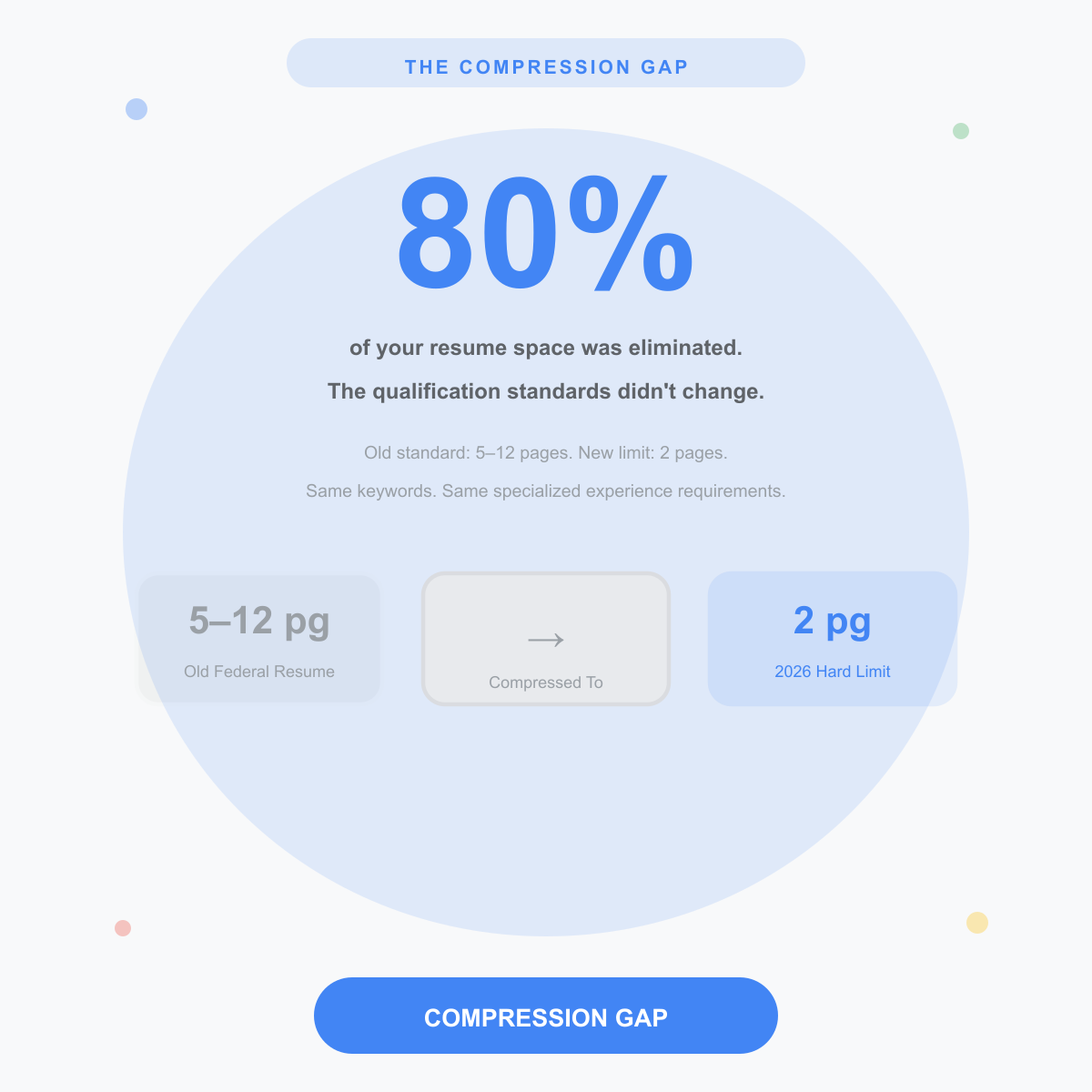
On September 27, 2025, USAJOBS introduced a hard cap: uploaded resumes cannot exceed two pages. For thousands of federal applicants who had spent years crafting detailed, keyword-rich narratives spanning five, eight, or even twelve pages, this felt like the ground shifting beneath their feet. But here is what most people missed in the initial panic: the qualification standards themselves did not change. Human Resources specialists still verify the same thing they always have — whether an applicant can demonstrate one year of specialized experience at the next lower grade level (or equivalent). The assessment criteria, the competency frameworks, the scoring rubrics — all unchanged.
What changed was the container. The page limit shrank by roughly 80%, but the burden of proof stayed exactly the same. You still need to show the same depth of evidence, the same keyword alignment, the same documented results. You just have dramatically less real estate in which to do it.
That gap between what the system now accepts and what the evaluators still require is what we call the Great Compression — and navigating it successfully demands a fundamentally different approach to federal resume strategy.
The Dual-Format Strategy
The federal hiring pipeline contains two gatekeepers with directly opposing demands. The first is the automated screening layer — the system that enforces the two-page upload restriction and performs initial keyword parsing. This gatekeeper rewards brevity, tight formatting, and ruthless prioritization. If your document exceeds the limit, it is rejected before a human ever reads a word.
The second gatekeeper is human: Subject Matter Expert panels, interview committees, and hiring managers who conduct deep-dive reviews. These evaluators want context, narrative, and comprehensive evidence. They want to understand the scope of your projects, the complexity of your decisions, and the measurable outcomes you produced. Two pages rarely satisfies their appetite for detail.
Trying to serve both gatekeepers with a single document is the trap. The solution is to stop trying.
Instead, you build two separate, purpose-built documents:
- Asset A — The 2-Page Submission Resume: A precision-engineered document designed exclusively for the USAJOBS upload. Every line is calibrated against the specific announcement's specialized experience requirements. Nothing extraneous survives.
- Asset B — The Master Resume: A comprehensive 5-to-10 page document containing your full professional narrative, complete project histories, and deep CCAR (Context-Challenge-Action-Result) stories. This is the document you bring to interviews, upload as a supplemental attachment when the announcement permits, and submit during reconsideration requests.
Neither document is a rough draft of the other. They are distinct instruments built for distinct audiences at distinct stages of the hiring funnel.
Building Asset A: The 2-Page Submission Resume
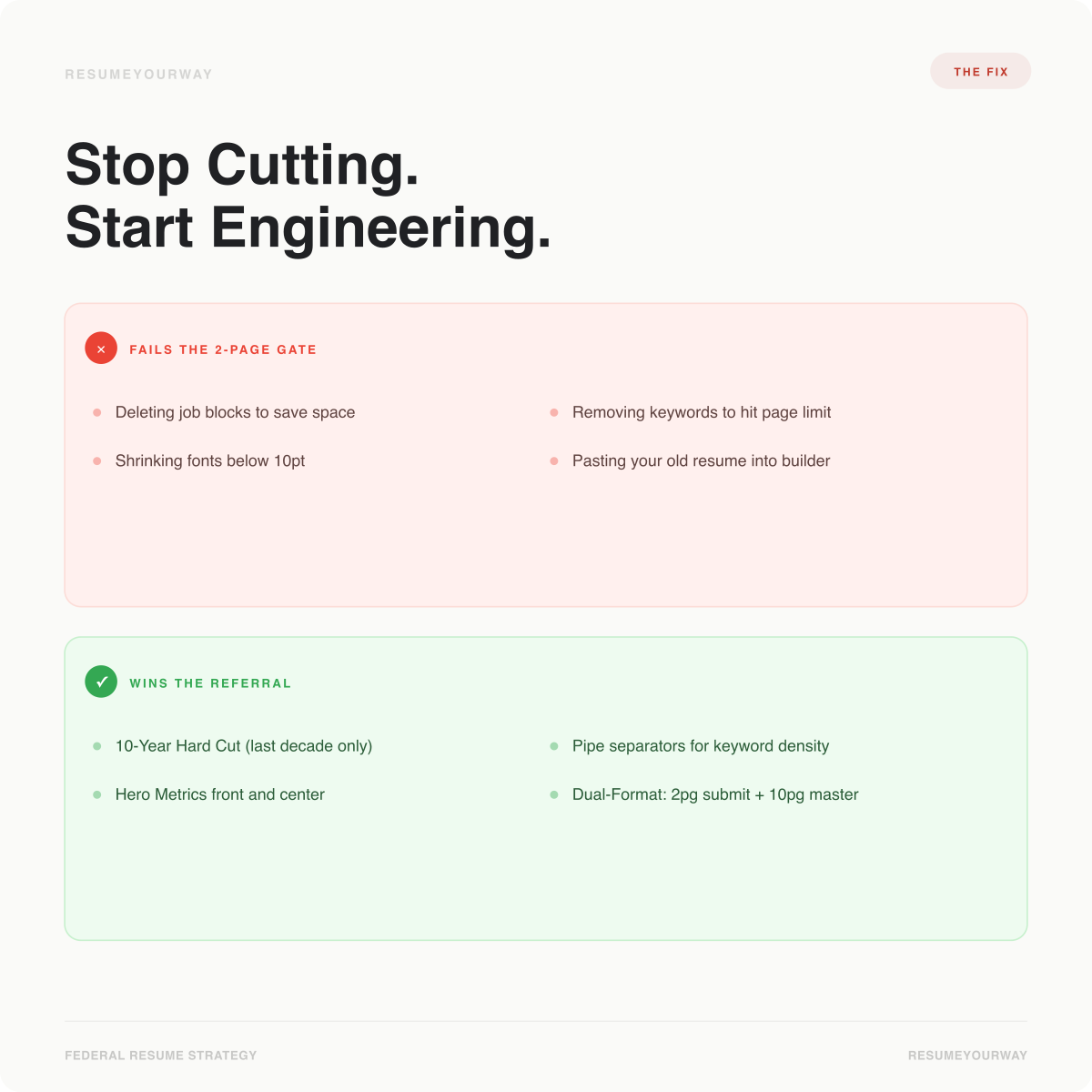
Compressing a federal career into two pages is not about shrinking fonts or trimming margins to absurd levels. It requires a systematic approach — six specific steps that reclaim space without sacrificing the qualification evidence HR needs to see.
Step 1: Reclaim the Header
Most federal resumes open with a block of personal information that consumes four to six lines: full mailing address, objective statement, references line, and sometimes a professional summary paragraph. Under the new constraints, that real estate is too expensive.
Strip the header down to a single line containing only what is mandatory or functionally necessary: your name, email address, phone number, citizenship status, and veteran's preference eligibility (if applicable). A full street address is not required on the USAJOBS upload — city and state are sufficient if you include them at all. Objective statements are universally ignored by federal HR specialists. References are never checked at the resume screening stage.
This single-line header format typically recovers 15 to 20 percent of your first page — space that can now hold three to four additional experience bullets.
Step 2: Compress Job Blocks into One-Liners
Traditional federal resume formatting dedicates three to four lines per position header: job title on one line, agency and department on another, dates and grade on a third, and sometimes hours per week on a fourth. Across four positions, that is 12 to 16 lines consumed by headers alone — nearly a quarter of a page.
Consolidate each position header into a single line: Job Title | Agency/Department | MM/YYYY - MM/YYYY | GS-XX | 40 hrs/wk. The pipe-delimited format is scannable, contains every required data point, and frees up enough vertical space for approximately eight additional accomplishment bullets across a four-position resume.
Step 3: Map to the Announcement, Not Your Career
This is the conceptual shift that separates competitive two-page resumes from those that simply feel incomplete. Your Asset A is not a career summary — it is an evidence brief tailored to one specific vacancy announcement.
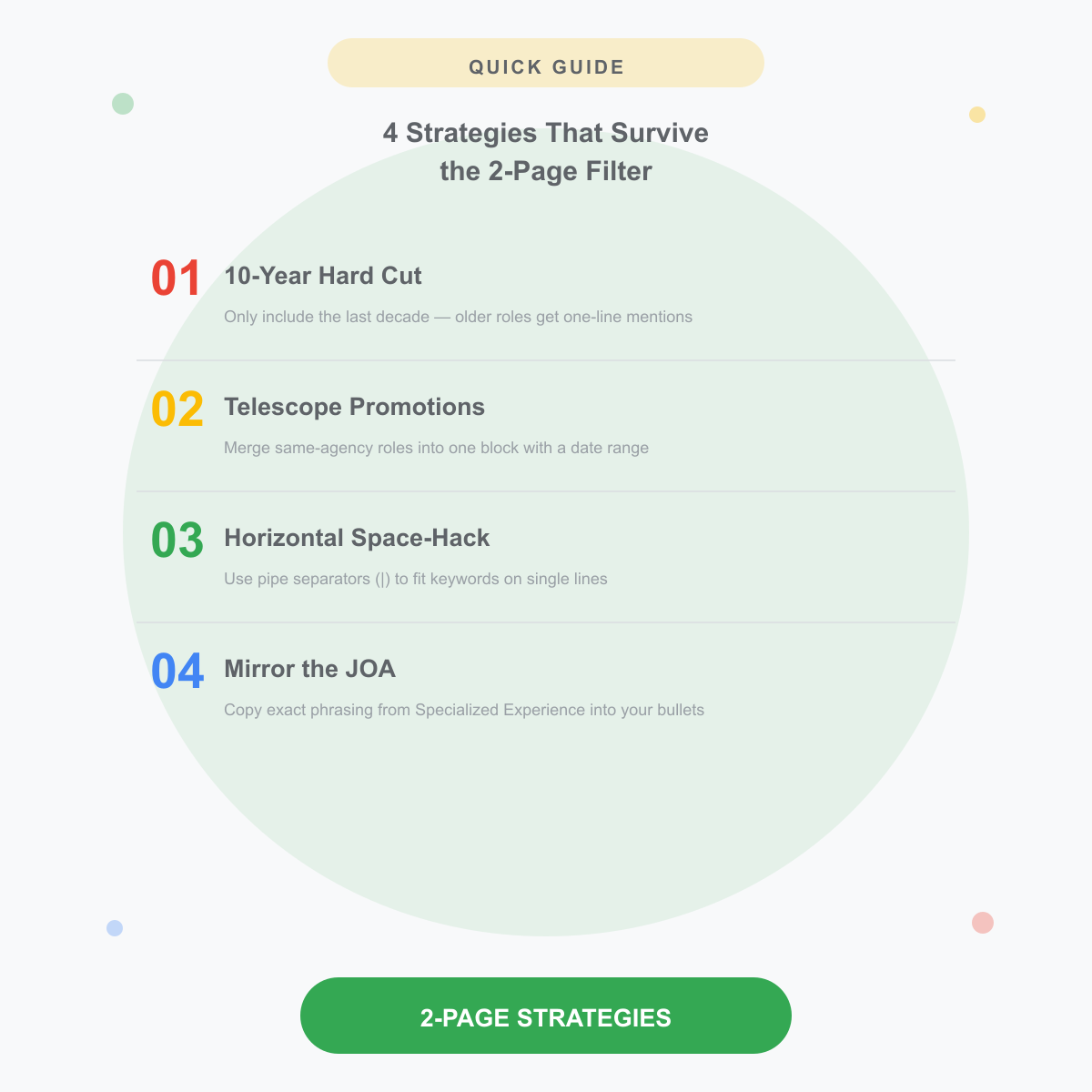
Pull the specialized experience language directly from the announcement. If the posting requires "experience managing cross-functional teams to deliver IT modernization projects within federal compliance frameworks," your bullets must mirror that language with concrete examples. Content that does not map to the stated qualifications — no matter how impressive — gets cut from Asset A. It belongs in Asset B.
Read the announcement's "Specialized Experience" and "How You Will Be Evaluated" sections as a checklist. Every bullet in Asset A should address at least one item on that checklist.
Step 4: Lead with Results, Not Duties
Duty-based bullets ("Responsible for managing a team of 12 analysts") consume space without demonstrating impact. Under the two-page constraint, every bullet needs to carry maximum weight.
Use the Result + Action Verb + Context formula: open with the measurable outcome, follow with what you did, and close with enough context to establish scope. For example: "Reduced processing backlog by 47% (1,200 cases cleared in 90 days) by redesigning the intake workflow and cross-training 8 staff members across 3 divisions."
This formula front-loads the impact — which is what both automated keyword parsers and human reviewers notice first — while embedding the duty description naturally within the context.
Step 5: Eliminate the Standalone Skills Section
A dedicated "Skills" or "Technical Competencies" block typically occupies four to eight lines listing software, certifications, and proficiencies in isolation. The problem is not just the space it consumes — it is that standalone skill lists lack the contextual anchoring that HR specialists need.
Federal qualification reviewers want to see where and when you applied each skill. "Proficient in Tableau" means little. "Built 14 executive dashboards in Tableau for the Deputy Secretary's quarterly performance reviews (2023-2025, Department of Energy)" tells a complete story in one line and naturally integrates the keyword.
Weave every critical keyword into your experience bullets with an employer name and date range attached. This eliminates the orphaned skills block and strengthens each bullet simultaneously.
Step 6: Technical Formatting Precision
With content optimized, the final step is formatting discipline:
- Margins: 0.5 inches on all sides. Going below 0.5" risks readability issues in some PDF viewers and printed copies.
- Font: Arial or Calibri at 10 point. Both are clean sans-serif fonts that render well in PDF and remain legible at smaller sizes. Avoid Times New Roman — its serifs consume slightly more horizontal space per character.
- PDF conversion: Always convert from Word using "Save As PDF" with the "Standard (publishing online and printing)" option. Do not use "Print to PDF" — it can alter spacing, shift line breaks, and occasionally push content onto a third page.
- Mandatory fields: Regardless of formatting choices, every position must include hours per week, employment dates (month and year), and series/grade level if federal. Omitting any of these gives HR grounds to rate you ineligible without further review.
Building Asset B: The Master Resume
Asset B is where the full depth of your career lives. This is the document that gives interview panels and selecting officials the complete picture that Asset A, by design, cannot provide.
Your master resume should run five to ten pages and include:
- Full CCAR narratives: Each major accomplishment expanded into the Context-Challenge-Action-Result framework with enough detail for an evaluator to understand scope, complexity, and your specific role within team efforts.
- Complete project histories: Multi-year initiatives, interagency collaborations, and programs you led or contributed to — with budget figures, team sizes, stakeholder counts, and timeline details.
- Older positions with full detail: Roles beyond the 10-year window that Asset A may abbreviate or omit entirely. These positions often contain relevant experience that interviewers will ask about.
- Complete KSA evidence: Knowledge, Skills, and Abilities documentation that demonstrates your qualifications beyond what fits in two pages. Include specific examples, training completions, and certifications with dates and issuing bodies.
Asset B serves three critical purposes: it is your interview preparation document (review it before every panel), your supplemental upload when announcements allow additional attachments through the "Other Documents" section, and your reconsideration evidence if you need to challenge an eligibility determination.
How Subject Matter Experts Actually Review Your Resume
Understanding the SME review process transforms how you write both assets. Most applicants treat the resume as a document that will be read carefully from top to bottom. The reality is far more pressured and selective.
Panel Structure
SME panels consist of a minimum of two subject matter experts, each serving at or above the vacancy's target grade level. Panel members review independently before conferring. When they disagree on an applicant's qualification rating, they must reach consensus through discussion — and if consensus fails, a third SME is brought in to break the tie. This structure means your resume needs to be unambiguous enough that two independent readers reach the same conclusion about your qualifications.
What They Actually Look For
SMEs are required to document written justifications for every rating decision, and those justifications must point to specific text in your resume. They cannot credit experience they infer or assume — if it is not explicitly written, it does not count. This is why vague bullets like "Led various IT projects" are dangerous: an SME cannot cite that language as evidence of the specific competency the announcement requires.
Panels evaluate against the announcement's competencies and specialized experience requirements. They are looking for direct, citable evidence — your exact words become their documentation. Write accordingly.
The 10-Day Pressure Cooker
Most SME panels operate under a 10-business-day window to review all qualified applicants for a given certificate. For competitive announcements, that can mean 50 to 200 resumes reviewed by a two-person panel in two weeks. The math produces rapid skimming — panels often spend three to five minutes per resume in the initial pass.
A densely formatted resume with precise keyword alignment and front-loaded results makes the SME's job easy. They can quickly find the evidence they need, cite it in their documentation, and move to the next applicant. A resume that buries relevant experience in paragraph form or uses creative synonyms instead of the announcement's exact terminology forces the SME to hunt — and under time pressure, hunting often means missing.
The "Other Documents" Decision Matrix
Whether to upload Asset B as a supplemental document depends entirely on the specific announcement. Not every vacancy allows additional uploads, and even when the option exists, the strategic calculus varies.
Review the announcement's "Required Documents" and "How to Apply" sections carefully. Some postings explicitly invite supplemental materials. Others restrict uploads to specific document types (transcripts, DD-214, SF-50). When an announcement says "you may include additional documentation to support your qualifications," that is a green light for Asset B.
When the announcement is silent on supplemental documents but the USAJOBS interface presents an "Other Documents" upload option, use judgment based on the position level. For GS-14 and above, supplemental documentation is generally expected and welcomed. For GS-7 through GS-12, the two-page submission carries most of the weight — but uploading Asset B rarely hurts if the option is available.
When the announcement explicitly states "do not submit additional materials beyond what is requested," respect that instruction. Uploading unrequested documents can signal that you do not follow directions — a red flag for any federal position.
Sector Exemptions: Where the 2-Page Rule Does Not Apply
Not every federal hiring pathway follows the same constraints. Three notable exemptions exist:
- Cyber Excepted Service (CES): Department of Defense cyber workforce positions hired under the Cyber Excepted Service authorities often operate outside standard USAJOBS formatting requirements. These positions frequently use their own application portals and may accept longer-format resumes or CVs. Always check the specific announcement — CES postings vary by component.
- Medical and Scientific Positions: Positions classified as CV-eligible (typically in research, medical, or scientific series) may require or accept curriculum vitae rather than standard resumes. CVs by nature run longer and follow academic formatting conventions rather than federal resume standards.
- Senior Executive Service (SES): SES hiring changed significantly in 2025. OPM eliminated the old 10-page ECQ narrative essay process. SES candidates now submit a 2-page resume like everyone else, with all five Executive Core Qualifications demonstrated within the resume itself. Assessment shifted to structured interviews conducted by the Qualifications Review Board. The 2-page constraint applies fully to SES applications. Some agencies may request a shorter Accomplishment Record during the selection process, but standalone ECQ essays are no longer part of the initial application.
The "10-Year Gap" Problem
Applicants with 20 or more years of federal service face a particular challenge under the new constraints. Two pages cannot hold two decades of detailed experience — and attempting to squeeze it all in produces a document so compressed it becomes unreadable.
The solution is a relevance filter applied chronologically. For positions held within the most recent 10 years (or the roles most directly relevant to the target announcement), write full detailed bullets using the Result + Action Verb + Context formula. These are the positions that carry the most weight with both automated screens and SME panels.
For older positions beyond that window, reduce each to a single-line entry: job title, agency, and employment dates. Nothing more. This preserves career continuity — evaluators can see you have a 25-year federal track record — without consuming the space that your most competitive, recent experience needs.
If an older position contains uniquely relevant experience that directly addresses the announcement's requirements, promote its most critical accomplishment into a single bullet. But be selective — one bullet from a 15-year-old position is worth including; five bullets from that same role means you are building a career summary instead of a targeted evidence brief.
Frequently Asked Questions
Is the 2-page limit actually enforced, or can I get around it?
Yes, it is enforced at the upload level. USAJOBS will reject files that exceed two pages when using the document upload option. The Resume Builder tool within USAJOBS does not impose a hard page limit in the same way (since it renders dynamically), but HR specialists increasingly expect concise submissions regardless of format. Building a tight two-page PDF gives you control over layout and ensures compliance with the upload restriction.
Should I use the USAJOBS Resume Builder or upload a PDF?
A custom-formatted PDF gives you significantly more control over space utilization, visual hierarchy, and keyword placement. The Resume Builder's fixed field structure often wastes space with redundant labels and rigid formatting that you cannot customize. However, some announcements specifically require the Resume Builder format — always check the "How to Apply" section. When you have the choice, a well-crafted PDF built in Word and converted properly will almost always produce a more competitive document.
What exactly is the Dual-Format Strategy?
It is the practice of maintaining two separate, purpose-built resume documents rather than trying to make one document serve every stage of the hiring process. Asset A is your concise, announcement-specific two-page submission optimized for the USAJOBS upload. Asset B is your comprehensive master resume (five to ten pages) used for interviews, supplemental uploads, and reconsideration requests. Each document is tailored to its specific audience and purpose — they are not simply long and short versions of the same content.
How do SME panels actually review federal resumes?
SME panels typically consist of two or more subject matter experts at or above the vacancy grade level. They review resumes independently, then confer on ratings. Each panelist must document written justifications that cite specific resume text — they cannot credit qualifications that are implied but not stated. Most panels operate under a 10-business-day window, which means they are scanning quickly. Resumes with clear keyword alignment and front-loaded results receive the most favorable evaluations because they make the SME's documentation task straightforward.
I have a 20+ year career. How do I fit that into two pages?
Apply a relevance filter. Your most recent positions (roughly the last 10 years) or the roles most directly relevant to the target announcement receive full detailed treatment with accomplishment bullets. Older positions get reduced to single-line entries showing only job title, agency, and dates. This preserves your career timeline without sacrificing the space your strongest, most current qualifications need. If an older role has one uniquely relevant accomplishment, promote that single bullet — but resist the urge to fully detail positions from 15 or 20 years ago.
Can I upload a longer document as "Other Documents" on USAJOBS?
It depends on the specific announcement. Some postings explicitly invite supplemental materials through the "Other Documents" section — that is an ideal place for your Asset B master resume. Other announcements restrict uploads to specific document types like transcripts or SF-50s. And some explicitly instruct applicants not to submit additional materials. Always read the "Required Documents" and "How to Apply" sections carefully. For GS-14 and above, supplemental documentation is generally expected when the option is available. For lower grades, the two-page submission typically carries the decision.
Need Help Building Both Resume Formats?
Every ResumeYourWay federal resume package includes both the 2-page submission document and the comprehensive master resume — built by 55+ Subject Matter Experts with a 92% interview success rate across 110,000+ clients since 2014.
View Federal Resume Packages Schedule Free ConsultationRelated Federal Resume Resources
- The 4 Merit Hiring Essay Questions Are a Trap
- What HR Specialists Actually See When They Screen Your Federal Resume
-
cR3eal8a;t etde xFte-ddeercaolr aRteisounm:e nRoenseo;u rfcoenst<-/whe2i>g"Blrioswts-es tAyllle :F endoenrea;l pRaedsduimneg :P a0c;k amgaersg <0/;l"i>><
tyle="margin-bottom: 0.75rem;"> The 4 Merit Hiring Essay Questions Are a Trap - What HR Specialists Actually See When They Screen Your Federal Resume
- Browse All Federal Resume Packages
Related reading: