
Your Federal Resume Is Costing You $30,000 a Year

She spent 14 years managing a $22 million federal program. Led a team of 38 across three agencies. Held a TS/SCI clearance. Her GS-13 salary was $112,000.
When the reduction-in-force notice arrived, she did what most federal professionals do: updated her resume, applied to private-sector roles, and waited. The first offer came in at $65,000. The second, $72,000. A recruiter told her she was "overqualified but underexperienced" -- a contradiction that makes sense only if you understand how the private sector reads federal resumes.
She wasn't lacking skills. She was lacking translation.
Her story is not unusual. In fact, it is quickly becoming the norm across a workforce in unprecedented upheaval. And the financial damage is staggering: tens of thousands of dollars in lost annual compensation, multiplied across hundreds of thousands of displaced professionals.
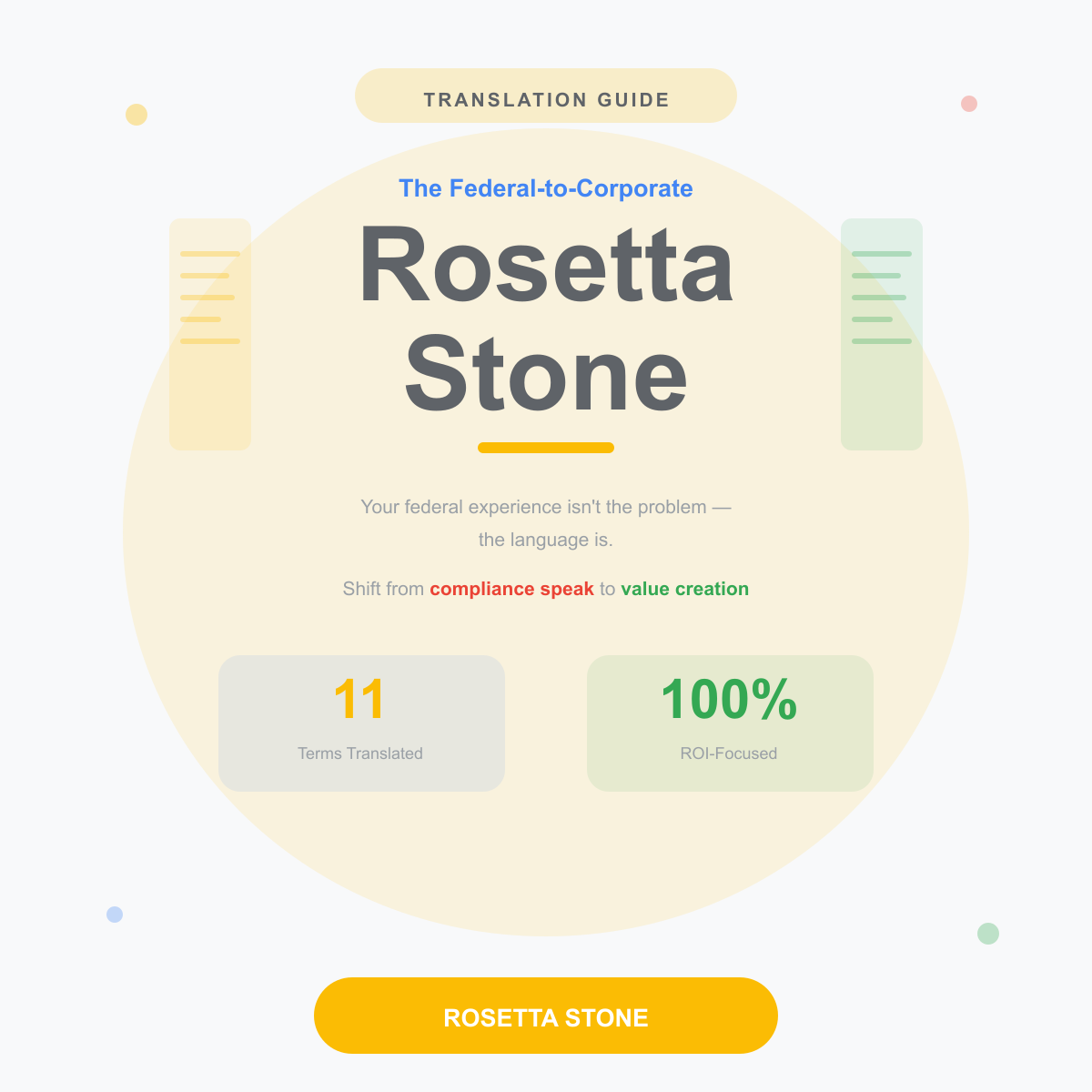
The Numbers Behind the Exodus
The scale of the 2026 federal workforce displacement is unlike anything in modern civil service history. Approximately 317,000 federal employees have departed their positions through a combination of mechanisms -- Deferred Resignation Programs (DRP), reductions in force (RIF), and voluntary separations driven by uncertainty.
To put that in perspective, the entire federal civilian workforce is roughly 2.3 million people. That means nearly 14% of the government's workforce has turned over in a matter of months.
The departures are not evenly distributed. Certain agencies have been hit disproportionately hard:
- Department of Education: Significant staffing reductions as restructuring proposals advance
- Environmental Protection Agency (EPA): Deep cuts to scientific and regulatory positions
- USAID: Near-complete operational drawdown in some program areas
- Department of Health and Human Services: Major consolidation affecting thousands of career employees
- Office of Personnel Management (OPM): Ironically, the agency overseeing federal employment has itself seen substantial reductions
The Deferred Resignation Program alone accounted for a massive wave of departures. Employees accepted the offer of continued pay through September 2025 in exchange for immediate departure, flooding the private-sector job market with experienced professionals who had never needed a private-sector resume before.
The Six-Second Problem
Here is the fundamental disconnect: a federal resume and a private-sector resume are completely different documents serving completely different audiences.
Federal resumes routinely run 5-7 pages. They are dense, detail-oriented, and structured around KSAs (Knowledge, Skills, and Abilities), series classifications, and grade-level language. This is by design -- USAJOBS automated screening systems reward thoroughness and keyword density.
Private-sector resumes operate on the opposite principle. Hiring managers and recruiters spend an average of six seconds on an initial resume scan. They want a tight, two-page document that leads with measurable outcomes, quantified achievements, and recognizable job titles. A seven-page federal resume is not just ineffective in this context -- it often gets discarded before a human ever reads it.
The mismatch creates a paradox. Federal professionals with decades of high-level experience appear less qualified on paper than candidates with half their tenure. Not because they lack capability, but because the document format itself obscures their value.
The Three Mistakes That Cost You Real Money
After working with thousands of federal-to-civilian transition clients, clear patterns emerge. Three resume mistakes appear over and over, and each one directly suppresses salary offers.
Mistake 1: Leading with Duties Instead of Outcomes
Federal position descriptions are written in duty-based language. "Responsible for oversight of..." and "Serves as the primary point of contact for..." are standard formats in PD language. But private-sector hiring managers do not care about what you were responsible for -- they care about what you actually accomplished.
Consider the difference:
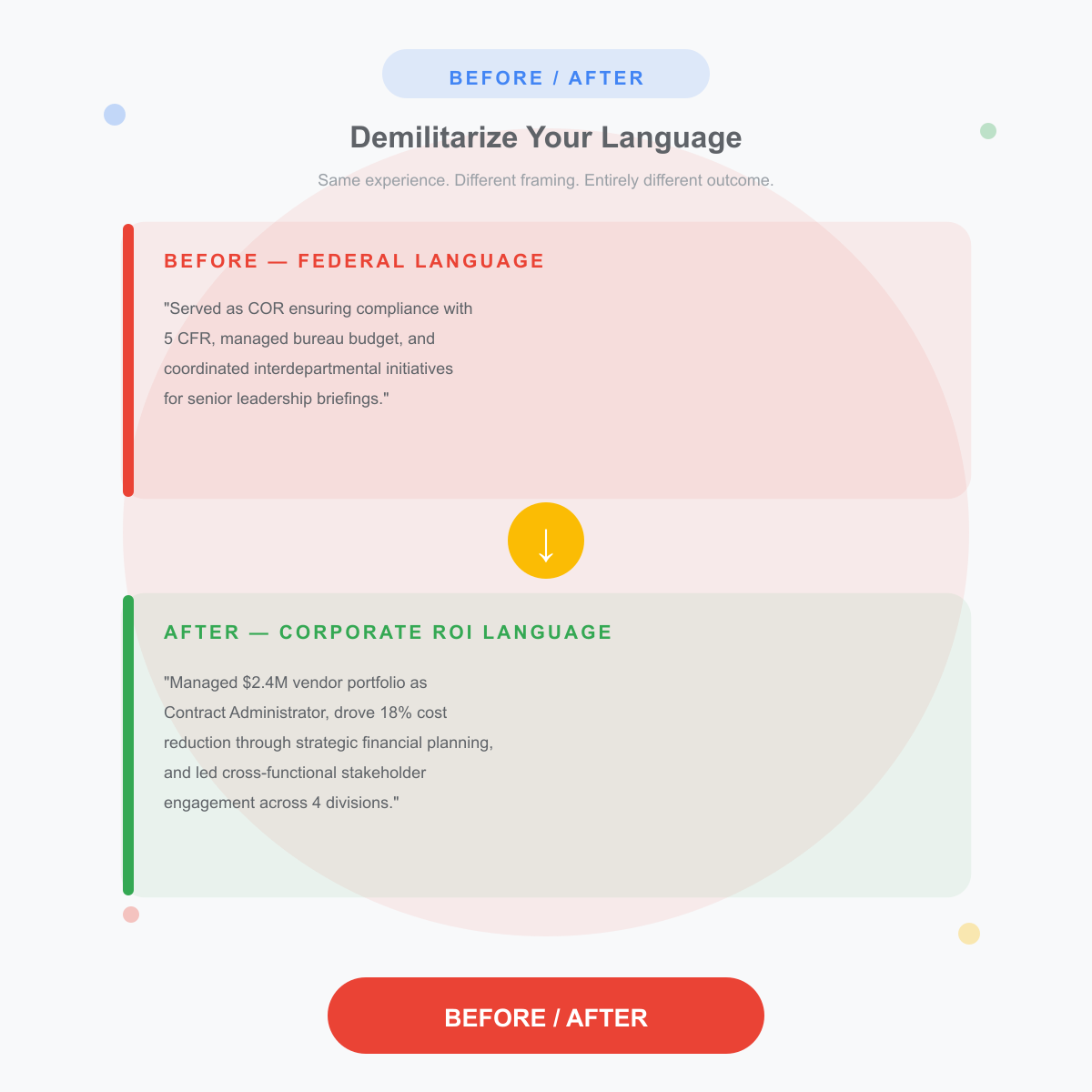
- Federal format: "Responsible for oversight of a $22M annual program budget across three regional offices."
- Translated format: "Directed $22M multi-site program, reducing operational costs 18% while increasing stakeholder satisfaction scores from 72% to 91%."
The first tells a recruiter what your job was. The second tells them what you are worth. That distinction can represent $15,000-$30,000 in starting salary.
Mistake 2: Relying on GS Levels as Shorthand for Seniority
Inside the federal system, saying "GS-14" instantly communicates a specific level of responsibility, salary band, and organizational authority. Outside the federal system, it means almost nothing.
Most private-sector recruiters have no framework for interpreting the General Schedule. A GS-14 could be a senior individual contributor or a division-level leader depending on the agency and role. Without explicit translation, recruiters default to conservative assumptions -- and conservative assumptions mean lower offers.
Mistake 3: Drowning in Acronyms and Jargon
Federal professionals communicate in a specialized vocabulary: ECQs, TQs, KSAs, PD, FTE, DPMAP, SES CDP, and dozens more. Each acronym carries precise meaning within the federal ecosystem and zero meaning outside of it.
When a resume is packed with unexplained federal terminology, it creates cognitive friction for the reader. And cognitive friction kills applications. Recruiters do not stop to decode acronyms -- they move to the next candidate.
GS-to-Corporate Translation: The Salary Cheat Sheet
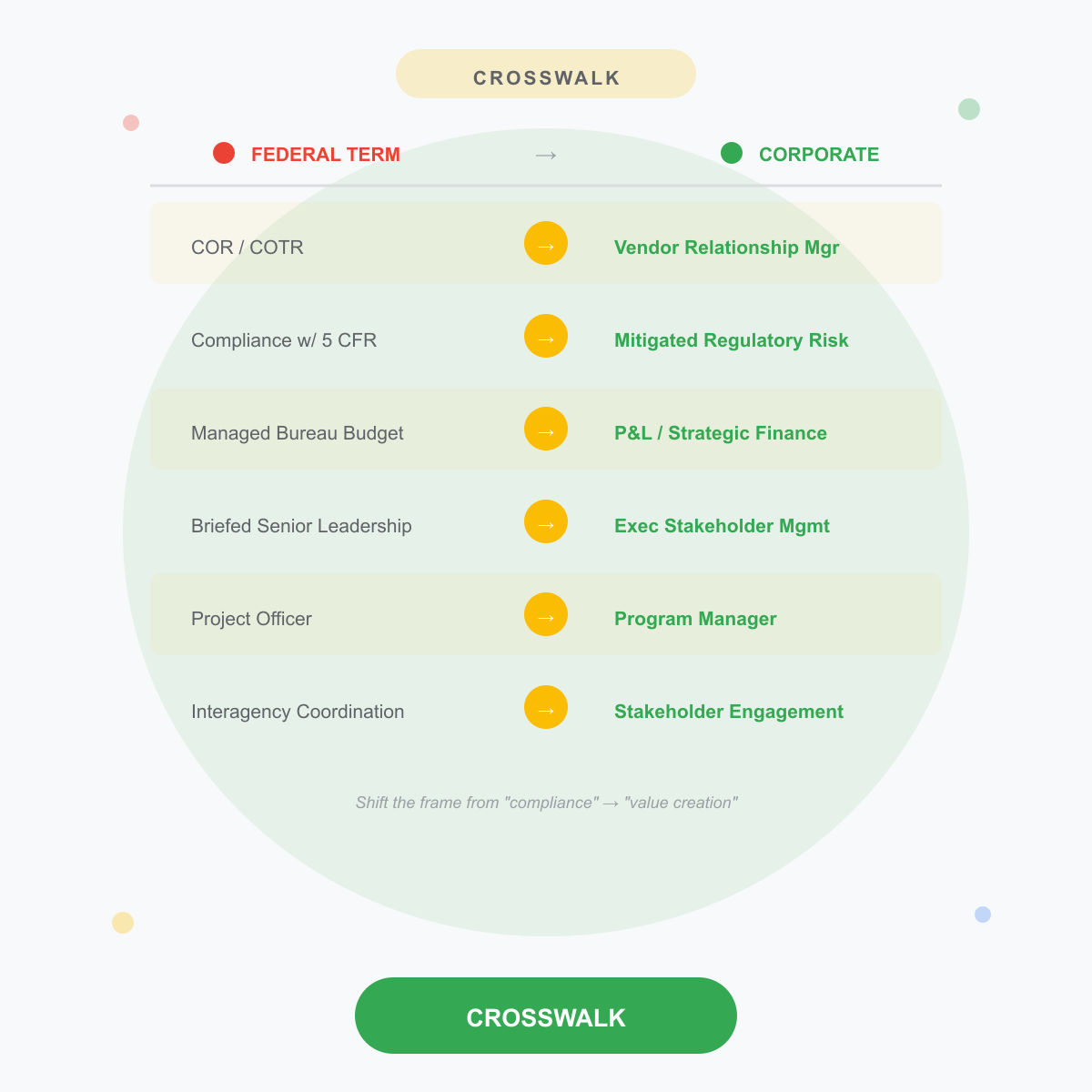
One of the most practical tools for federal professionals entering the private sector is understanding how GS levels translate to corporate titles and salary ranges. This mapping is not perfect -- it varies by industry, company size, and geography -- but it provides a critical anchor point for salary negotiations.
- GS-11 / GS-12: Typically maps to Senior Analyst, Team Lead, or Project Manager roles. Private-sector salary range: $75,000-$110,000 depending on industry and metro area.
- GS-13: Aligns with Senior Manager, Program Director, or Principal Consultant positions. Expected range: $100,000-$140,000.
- GS-14: Equivalent to Director, Vice President (at smaller firms), or Senior Director. Range: $130,000-$180,000.
- GS-15: Maps to Vice President, Senior Vice President, or Managing Director. Range: $160,000-$220,000+.
- SES (Senior Executive Service): C-suite equivalency -- Chief Operating Officer, Executive Vice President, or divisional President. Range: $200,000-$350,000+ with equity and bonus structures.
Notice the gap between the federal salary for a GS-13 ($112,000 in the DC locality) and the private-sector ceiling for equivalent roles ($140,000). That gap is real, but only accessible if your resume communicates your value in terms the private sector understands.
If your translated resume undersells you -- leading with duties, hiding behind GS classifications, and drowning in acronyms -- you will land on the low end of those ranges. Or worse, below them entirely.
The DRP Gap: Turning a Liability Into a Strength
Thousands of federal employees who accepted the Deferred Resignation Program now face an awkward gap on their resumes. They were technically still on the payroll through September 2025 but were not performing federal duties. How do you explain that to a hiring manager?
The worst approach is to leave it blank or try to hide it. Employment gaps raise red flags, and unexplained ones raise even bigger ones.
The better approach is to reframe the period as a Strategic Professional Development Sabbatical. During this time, you should have been -- and ideally were -- doing things that increase your market value:
- Pursuing industry certifications (PMP, Six Sigma, SHRM, CISSP)
- Completing professional development coursework
- Building your professional network in target industries
- Conducting informational interviews and industry research
- Volunteering or consulting in your area of expertise
Even if you spent the first few weeks processing the change, you can still build a credible narrative around professional development. The key is intentionality: showing that you used the transition period strategically rather than passively.
Schedule Policy and Career: The At-Will Reality
Many displaced federal employees held Schedule C, Schedule Policy, or other non-competitive service appointments. These positions carry a particular challenge in the private sector: they were political or policy-level appointments, and some hiring managers view them with caution.
The reclassification to at-will employment is a significant psychological and practical shift. Federal employment -- particularly competitive service -- comes with layers of due process protections. The private sector operates on fundamentally different terms.
However, there is a major asset that many displaced federal professionals undervalue: their security clearance. An active TS/SCI clearance is worth a significant salary premium in the defense, intelligence, and government contracting sectors. Estimates vary, but professionals with active clearances typically command 15-25% higher compensation than equivalent candidates without them.
The critical factor is timing. Security clearances begin to degrade once you are no longer in a position that requires access. The clock starts the day you leave federal service, and full reinvestigation can take 12-18 months. This creates urgency around the job search that many transitioning professionals do not fully appreciate until it is too late.
The Referral Wall: Why USAJOBS Thinking Fails in the Private Sector
Federal job searches and private-sector job searches reward completely different behaviors. In the federal system, the process is formal, structured, and largely anonymous. You submit an application through USAJOBS, a human resources specialist reviews it against qualification requirements, and the system produces a certificate of eligible candidates. Networking plays a minimal role.
The private sector inverts this model entirely. Research consistently shows that referrals account for 30-50% of all hires at most companies. At the executive level, that figure is even higher. The overwhelming majority of mid-to-senior positions are filled through professional networks before they ever appear on a job board.
Federal professionals who apply the USAJOBS mindset to private-sector searches -- submitting applications through portals and waiting -- are competing at a structural disadvantage. The candidates getting hired are the ones working their networks: reaching out to former colleagues in the private sector, attending industry events, engaging on LinkedIn, and requesting introductions to hiring managers.
This is not a soft skill. It is a hard requirement of the private-sector hiring process.
The Benefits Clock: Critical Deadlines You Cannot Miss
Beyond salary negotiations and resume translation, federal professionals face a series of time-sensitive decisions around benefits continuity. Missing these deadlines can cost thousands of dollars in coverage gaps and lost accrued value.
Federal Employees Health Benefits (FEHB)
You have 31 days from your separation date to convert your FEHB coverage to an individual plan or enroll in COBRA-equivalent temporary continuation of coverage (TCC). TCC lasts 18 months but requires you to pay both the employee and employer shares -- making it significantly more expensive than your active-duty premium.
Thrift Savings Plan (TSP)
Your TSP account remains yours regardless of employment status. However, contribution matching stops immediately upon separation. You can leave funds in the TSP (which has extremely low expense ratios compared to most 401(k) plans), roll them into a new employer's plan, or transfer to an IRA. Each option has tax implications worth discussing with a financial advisor before acting.
Annual and Sick Leave
Unused annual leave is paid out as a lump sum upon separation. Unused sick leave is not paid out but may be credited toward your federal retirement computation if you return to federal service later. Keep documentation of your sick leave balance -- it could be valuable years from now.
Pension and FERS
If you have fewer than 5 years of creditable service, you are not vested in the FERS basic benefit. If you have 5+ years, your annuity calculation depends on your high-3 average salary and years of service. Deferred retirement is available at age 62 with 5+ years, or at your minimum retirement age with 10+ years (at a reduced rate).
The Playbook: Five Steps to Stop Losing Money
Here is the concrete action plan for translating your federal career into a private-sector resume that commands what you are actually worth.
Step 1: Eliminate the Master Resume
Stop sending the same 5-7 page federal resume to every opening. Create a 2-page private-sector resume that is tailored for each target role. Yes, this means more work per application. It also means dramatically higher response rates.
Step 2: Lead with a Skills-Based Summary
Replace your federal "Objective" or "Professional Summary" with a skills-forward statement that immediately communicates three things: what you do, how well you do it, and the measurable impact you create. This is the section recruiters read during their six-second scan.
Step 3: Translate Every Title
Do not assume anyone outside government understands federal job series or grade classifications. For each position, include both your official federal title and a parenthetical corporate-equivalent title. Example: "Management and Program Analyst, GS-13 (equiv. Senior Program Manager)."
Step 4: Quantify Relentlessly
Every bullet point on your resume should include at least one number: dollars managed, people led, percentage improved, time saved, or scope covered. Federal professionals often have access to impressive metrics -- budget sizes, team headcounts, program reach -- but fail to feature them prominently.
Step 5: Reverse-Engineer Job Postings
Before writing a single bullet point, read 10-15 job postings in your target role. Identify the recurring keywords, required skills, and valued qualifications. Then write your resume to mirror that language. This is not about dishonesty -- it is about presenting your genuine experience in the vocabulary your audience actually uses.
The Stigma Is Real -- But the Data Is on Your Side
There is an uncomfortable truth that many career coaches avoid: some private-sector hiring managers carry bias against federal employees. Stereotypes about government workers -- slow, risk-averse, bureaucratic -- persist despite being largely inaccurate.
But the data tells a different story. The Federal Employee Viewpoint Survey consistently shows federal employees scoring a 74.4 on the Global Engagement Index, comparable to or exceeding private-sector benchmarks. Federal professionals manage enormous budgets, navigate complex stakeholder environments, and operate under levels of scrutiny that most corporate managers never experience.
More importantly, the broader labor market is shifting in your favor. Skills-based hiring -- where employers evaluate candidates based on demonstrated capabilities rather than pedigree or employer brand -- is accelerating across every major industry. Companies that once filtered for Fortune 500 experience are actively seeking candidates who bring different perspectives, including government experience.
The key is positioning. You need a resume that translates your federal experience into private-sector value, a LinkedIn presence that signals industry relevance, and a networking strategy that puts you in front of decision-makers before job postings go live.
The $30,000 annual salary gap between a poorly translated federal resume and a professionally positioned one is not theoretical. It compounds every year. Over a 10-year post-federal career, that gap represents $300,000 or more in lifetime earnings.
The investment in getting the translation right pays for itself before your first paycheck clears.
Ready to Translate Your Federal Career?
ResumeYourWay's federal-to-civilian transition packages are built by 55+ Subject Matter Experts who've made the same jump. 92% interview rate. 110,000+ professionals served since 2014.
View Transition Packages Schedule Free ConsultationRelated Federal Resume Resources
- The 2-Page Federal Resume Is a Trap
- What HR Specialists Actually See When They Screen Your Federal Resume
-
.B5rroewms;e mAalrlg iFne-dbeortatlo mR:e s1urmeem ;P afcoknatg-essi
<1/.l4ir>e >Related Federal Resume Resources

Get the resume that gets you interviews.
110,000+ careers since 2014. 100% human-written. Built for your exact situation.
No AI. No templates. Veteran-owned.